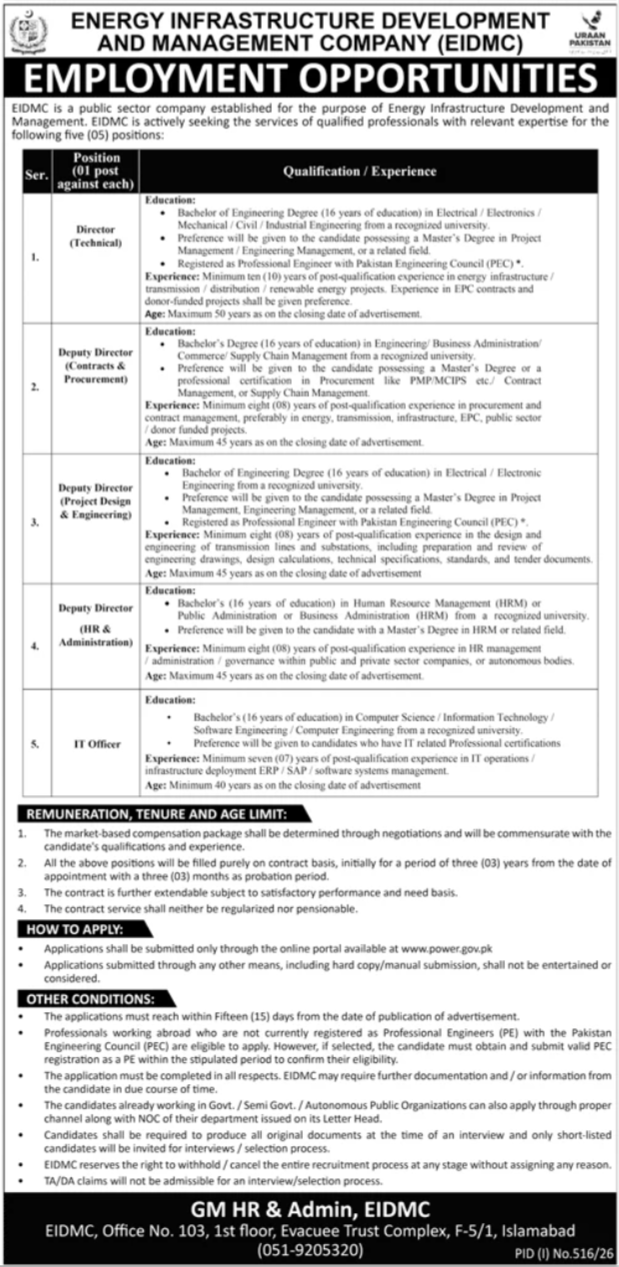
- Salary Offer 75000-85000 USD 75000-85000 Month
- Address Islamabad, Islamabad, Pakistan
- Age limit 20-30
- Gender Both
- Job Sector Government
- Apply Through By Hand
- Job Authority
- Number of Post Multiples
- Education Bachelor | Master | MS | BS
- TA/DA No
- Domicile Islamabad, Islamabad, Pakistan
- Newspapper Jang Jobs
- Experience Required Fresh Can Apply
- Official Website https://e.jang.com.pk/lahore/19-07-2026/page10
| Posted On | |
|---|---|
| Company: | |
| Location: | |
| Job Type: | |
| Last Date: |
Jobs Positions
An Energy Infrastructure & Management Company plays a critical role in ensuring the reliable production, transmission, distribution, and efficient use of energy resources. These companies design, build, operate, and maintain the physical systems that deliver electricity, natural gas, renewable energy, and other energy sources to homes, businesses, and industries. As global energy demand continues to increase, the importance of modern and sustainable energy infrastructure has become greater than ever before.
Energy infrastructure consists of power plants, transmission lines, substations, pipelines, renewable energy facilities, storage systems, and distribution networks. These assets form the backbone of any country’s economic development because almost every sector depends on a stable and uninterrupted energy supply. An Energy Infrastructure & Management Company ensures that these systems operate safely, efficiently, and economically while meeting environmental and regulatory standards.
One of the primary responsibilities of such a company is planning and developing energy projects. This involves conducting feasibility studies, assessing energy demand, selecting appropriate technologies, and designing infrastructure that meets current and future requirements. Proper planning helps reduce construction costs, improve operational efficiency, and minimize environmental impacts. Companies also collaborate with governments, investors, and local communities to ensure projects align with national development goals.
Construction and maintenance are equally important functions. Energy infrastructure projects require advanced engineering, skilled labor, and strict adherence to safety standards. Once facilities become operational, regular inspections and preventive maintenance are necessary to ensure reliability and extend the lifespan of equipment. Predictive maintenance technologies, including sensors and artificial intelligence, are increasingly being used to identify potential failures before they occur, reducing downtime and maintenance expenses.
Energy management focuses on optimizing the production, distribution, and consumption of energy. Companies use advanced monitoring systems, smart meters, and digital control technologies to analyze energy usage in real time. This enables operators to balance energy supply with demand, improve system performance, reduce transmission losses, and lower operating costs. Effective energy management also supports sustainability by minimizing waste and promoting energy conservation.
The rapid growth of renewable energy has transformed the energy industry. Modern Energy Infrastructure & Management Companies are investing heavily in solar farms, wind power projects, hydroelectric facilities, and battery energy storage systems. These renewable technologies help reduce dependence on fossil fuels and lower greenhouse gas emissions. However, integrating renewable energy into existing power grids requires advanced management systems because renewable sources often produce variable amounts of electricity depending on weather conditions.
Digital transformation has become another key aspect of energy management. Companies now employ technologies such as the Internet of Things (IoT), artificial intelligence (AI), cloud computing, and data analytics to improve operational efficiency. Smart grids enable two-way communication between energy providers and consumers, allowing for better demand forecasting, faster fault detection, and improved grid reliability. Digital tools also support remote monitoring and automated decision-making, making energy systems more resilient and responsive.
Environmental responsibility is a major priority for today’s energy companies. Governments and international organizations have introduced stricter environmental regulations to reduce pollution and combat climate change. As a result, Energy Infrastructure & Management Companies implement sustainable practices such as carbon reduction strategies, energy-efficient technologies, waste management programs, and environmental impact assessments. Many organizations are also adopting net-zero emission goals and investing in clean energy innovations to support long-term sustainability.
Risk management is another essential function. Energy infrastructure is exposed to various risks, including natural disasters, cyberattacks, equipment failures, market fluctuations, and regulatory changes. Companies develop comprehensive risk assessment and emergency response plans to protect critical assets and maintain continuous operations. Cybersecurity has become especially important as energy systems become increasingly connected through digital networks.
Human resources and workforce development contribute significantly to the success of these companies. Engineers, technicians, project managers, environmental specialists, data analysts, and safety professionals work together to ensure projects are completed efficiently and safely. Continuous training and professional development help employees adapt to emerging technologies and changing industry standards.
Looking ahead, the future of Energy Infrastructure & Management Companies will be shaped by innovation, sustainability, and digitalization. Investments in hydrogen energy, carbon capture technologies, electric vehicle charging infrastructure, and decentralized energy systems are expected to create new opportunities for growth. Companies that successfully combine technological innovation with responsible environmental management will play a leading role in achieving global energy security and sustainable economic development.
In conclusion, Energy Infrastructure & Management Companies are essential for building and maintaining the systems that power modern societies. Their responsibilities extend beyond constructing energy facilities to managing resources efficiently, integrating renewable energy, ensuring operational reliability, and promoting environmental sustainability. By embracing advanced technologies and sustainable practices, these companies contribute significantly to economic growth, energy security, and the transition toward a cleaner and more resilient energy future.