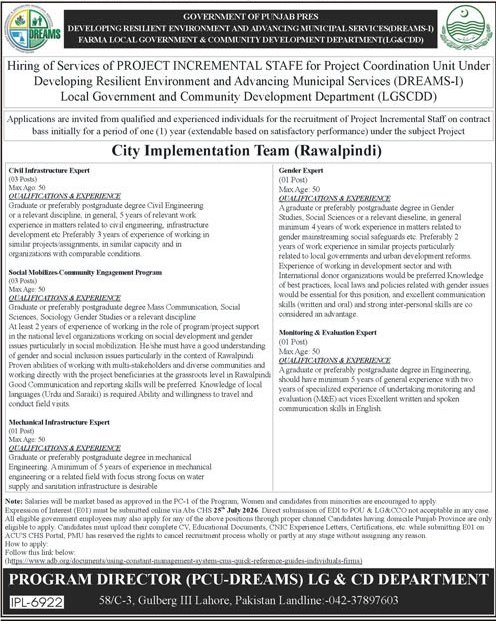
- Salary Offer 70000-80000 USD 70000-80000 Month
- Address Lahore, Punjab, Pakistan
- Age limit 20-30
- Gender Both
- Job Sector Governament
- Apply Through By Hand
- Job Authority
- Number of Post Multiples
- Education Bachelor | Master | MS | BS
- TA/DA No
- Domicile Punjab,Sindh,Balochistan,kpk
- Newspapper Mashriq Jobs
- Experience Required Fresh Can Apply
- Official Website https://mashriqakhbar.com.pk/page/p2/2026-07-08/1
| Posted On | |
|---|---|
| Company: | |
| Location: | |
| Job Type: | |
| Last Date: |
Jobs Positions
The Local Government & Community Development (LG & CD) Department plays a vital role in promoting local governance, improving public services, and supporting community development at the grassroots level. It serves as the primary government institution responsible for strengthening local government systems, enhancing citizen participation, and ensuring the efficient delivery of municipal services. Through effective planning, policy implementation, and coordination with local authorities, the department contributes significantly to sustainable social and economic development.
The LG & CD Department works to empower local governments by providing administrative, technical, and financial support. It develops policies and legal frameworks that guide the functioning of municipal corporations, metropolitan corporations, district councils, town committees, and union councils. These local government institutions are responsible for addressing the everyday needs of citizens, including sanitation, waste management, water supply, street lighting, parks, roads, public health, and community welfare. The department ensures that these institutions operate effectively and in accordance with government regulations.
One of the department’s major responsibilities is policy formulation. It prepares laws, rules, regulations, and guidelines that strengthen local governance and improve service delivery. These policies encourage transparency, accountability, decentralization, and public participation in decision-making. By establishing clear administrative procedures and governance standards, the department helps local governments perform their responsibilities more efficiently.
Community development is another important function of the LG & CD Department. The department designs and implements programs that improve the social and economic well-being of local communities. These initiatives may include poverty reduction projects, women’s empowerment programs, youth development, vocational training, environmental protection, rural development, and neighborhood improvement schemes. Such programs aim to enhance the quality of life while encouraging active participation from community members.
The department also plays a significant role in infrastructure development. It collaborates with local governments to plan, construct, rehabilitate, and maintain public infrastructure such as roads, drainage systems, public buildings, community centers, parks, markets, and recreational facilities. Well-maintained infrastructure supports economic growth, improves public safety, and enhances the overall living conditions of residents.
Financial management is an essential responsibility of the LG & CD Department. The department allocates development funds to local government institutions, monitors budget utilization, and ensures financial accountability. It establishes financial management systems that promote efficient resource allocation and transparent expenditure. Regular audits, financial reporting, and performance monitoring help ensure that public funds are used responsibly and effectively.
Capacity building is another key area of focus. The department organizes training programs, workshops, seminars, and technical assistance for elected representatives, government officials, and administrative staff. These activities strengthen leadership skills, improve administrative efficiency, and introduce modern management practices. Continuous professional development enables local government officials to respond more effectively to the changing needs of their communities.
Citizen participation is fundamental to the department’s mission. The LG & CD Department encourages public involvement through community consultations, public hearings, awareness campaigns, and participatory planning processes. Residents are given opportunities to express their concerns, suggest development priorities, and contribute to local decision-making. This collaborative approach increases transparency, strengthens public trust, and ensures that development projects reflect community needs.
The department also coordinates with provincial and federal government agencies, development organizations, non-governmental organizations (NGOs), and international partners. These partnerships support the implementation of development projects, technical assistance programs, and capacity-building initiatives. Collaborative efforts enable local governments to access additional financial resources, technical expertise, and innovative solutions for addressing urban and rural challenges.
Technology has become increasingly important in modern local government administration. The LG & CD Department promotes digital governance by introducing online services, electronic record management, digital payment systems, geographic information systems (GIS), and management information systems (MIS). These technological improvements enhance administrative efficiency, improve transparency, reduce paperwork, and provide citizens with easier access to government services.
Environmental sustainability is another important priority. The department supports projects related to waste management, urban greening, climate resilience, renewable energy, water conservation, and environmental protection. Local governments are encouraged to adopt environmentally responsible practices that reduce pollution, improve public health, and promote sustainable urban development for future generations.
Despite its important role, the LG & CD Department faces several challenges. Rapid urbanization, population growth, limited financial resources, aging infrastructure, climate change, administrative constraints, and increasing public expectations require continuous reforms and effective management. Addressing these challenges requires strong leadership, adequate funding, institutional capacity, and close cooperation between government agencies and local communities.
To overcome these challenges, the department continuously works on governance reforms aimed at improving transparency, accountability, efficiency, and service delivery. Modern management systems, digital transformation, stronger financial controls, enhanced monitoring mechanisms, and citizen-centered policies contribute to better governance outcomes. The department also encourages innovation and evidence-based planning to ensure sustainable development at the local level.
In conclusion, the Local Government & Community Development Department serves as a cornerstone of effective local governance and community development. Through policy development, administrative support, financial management, infrastructure planning, citizen engagement, environmental sustainability, and institutional capacity building, the department helps improve the quality of public services and promotes inclusive development. Its continued commitment to strengthening local governments and empowering communities remains essential for achieving sustainable economic growth, social progress, and improved living standards for citizens.