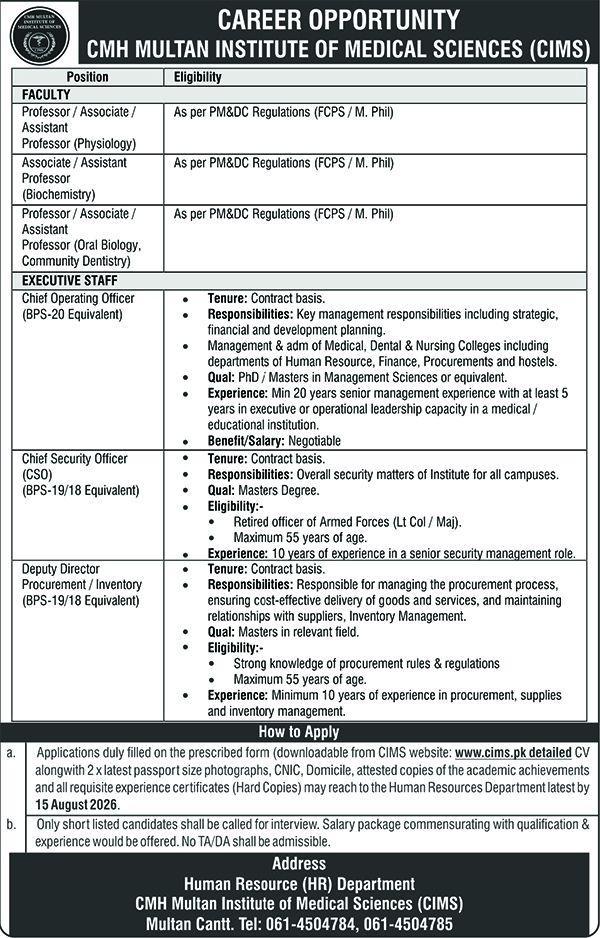
- Salary Offer 72000-80000 USD 72000-80000 Month
- Address Multan, Punjab, Pakistan
- Age limit 20-30
- Gender Both
- Job Sector Government
- Apply Through By Hand
- Job Authority
- Number of Post Multiples
- Education Bachelor | Master | Mphil | Phd
- TA/DA No
- Domicile Punjab,Sindh,Balochistan,kpk
- Newspapper Nawaiwaqt Jobs
- Experience Required Fresh Can Apply
- Official Website https://www.nawaiwaqt.com.pk/E-Paper/lahore/2026-07-26/page-2
| Posted On | |
|---|---|
| Company: | |
| Location: | |
| Job Type: | |
| Last Date: |
Jobs Positions
The Multan Institute of Medical Sciences (CIMS) has emerged as a respected institution dedicated to advancing medical education, professional training, and healthcare services in Pakistan. As the demand for qualified healthcare professionals continues to grow, institutions like CIMS play a significant role in preparing students with the knowledge, clinical expertise, and ethical values required to meet modern healthcare challenges. By combining academic learning with practical experience, the institute contributes to the development of competent medical professionals capable of serving communities with dedication and professionalism.
Medical education has evolved significantly over the past decade, requiring institutions to adopt innovative teaching methods and updated academic curricula. CIMS focuses on providing students with a learning environment that encourages scientific thinking, clinical competence, and continuous professional development. Through classroom instruction, laboratory sessions, and clinical exposure, students gain a balanced understanding of both theoretical concepts and practical medical applications.
One of the defining features of a modern medical institute is its commitment to quality education. CIMS emphasizes structured academic programs that align with contemporary healthcare standards. Students receive guidance from experienced faculty members who bring academic knowledge and professional experience into the classroom. Interactive lectures, case-based discussions, practical demonstrations, and problem-solving activities help learners strengthen their analytical and clinical decision-making skills.
Practical training is an essential component of healthcare education. Medical students benefit from supervised clinical rotations that allow them to observe patient care, understand diagnostic procedures, and develop communication skills with patients and healthcare teams. Exposure to real healthcare environments enhances confidence and prepares students to handle professional responsibilities effectively after graduation.
Laboratory education also plays a vital role in medical training. Well-equipped laboratories provide students with opportunities to perform scientific experiments, understand human anatomy and physiology, study microbiology, biochemistry, pathology, and develop technical competencies. Hands-on laboratory experience bridges the gap between classroom learning and clinical practice while encouraging evidence-based medical education.
Research has become an increasingly important aspect of higher medical education. Institutions such as CIMS encourage students and faculty members to participate in research activities that contribute to healthcare improvement and scientific advancement. Research projects promote critical thinking, innovation, and evidence-based decision-making. Students gain valuable experience in data collection, analysis, academic writing, and scientific presentation, preparing them for future academic and professional careers.
Modern healthcare relies heavily on technology, making digital learning an important element of medical education. CIMS promotes the use of educational technologies, online learning resources, digital libraries, and virtual learning platforms that support flexible and interactive education. Access to current medical literature and digital educational tools enables students to remain informed about emerging healthcare trends and international best practices.
Healthcare education extends beyond academic excellence by emphasizing ethics, professionalism, and compassionate patient care. Students are encouraged to uphold professional integrity, maintain patient confidentiality, respect cultural diversity, and demonstrate empathy during clinical interactions. Ethical medical practice strengthens public trust and ensures high-quality healthcare delivery across different communities.
Faculty development is another important factor contributing to institutional success. Continuous professional training enables educators to update their teaching methods, integrate modern medical knowledge, and adopt innovative instructional strategies. Professional development workshops, academic conferences, and collaborative learning opportunities support the continuous improvement of educational quality.
Community engagement remains an important responsibility for medical institutions. Health awareness campaigns, medical screening programs, vaccination initiatives, public health education, and outreach activities allow students to apply their knowledge while serving society. Such programs enhance practical learning experiences and strengthen the relationship between healthcare institutions and local communities.
The healthcare sector increasingly values multidisciplinary collaboration. Medical professionals work alongside nurses, pharmacists, physiotherapists, laboratory technologists, nutritionists, and healthcare administrators to provide comprehensive patient care. Educational institutions prepare students to function effectively within multidisciplinary healthcare teams by promoting teamwork, communication, leadership, and collaborative problem-solving.
Quality assurance remains central to institutional development. Regular curriculum evaluation, student feedback, academic assessments, and continuous improvement initiatives help maintain educational standards. Modern assessment methods evaluate not only theoretical knowledge but also clinical skills, communication abilities, professionalism, and critical thinking. This comprehensive approach ensures graduates are prepared for real-world healthcare environments.
Career opportunities for medical graduates continue to expand across hospitals, healthcare organizations, research institutions, educational establishments, public health agencies, and private medical facilities. Graduates may pursue careers in clinical medicine, medical education, healthcare administration, medical research, community health, and specialized medical fields. Continuous professional education and postgraduate training further enhance career advancement and specialization opportunities.
Innovation continues to shape the future of medical education. Artificial intelligence, telemedicine, electronic health records, simulation-based learning, and digital diagnostics are transforming healthcare delivery worldwide. Medical institutions increasingly introduce students to these emerging technologies, ensuring graduates possess the knowledge and adaptability required in a rapidly evolving healthcare landscape.
The institute also encourages lifelong learning, recognizing that medical knowledge continuously evolves. Healthcare professionals must regularly update their skills through workshops, certifications, conferences, and continuing medical education programs. Developing a habit of lifelong learning enables graduates to remain competent, informed, and responsive to changing healthcare needs throughout their professional careers.
In conclusion, the Multan Institute of Medical Sciences (CIMS) represents an important contributor to healthcare education by promoting academic excellence, clinical competence, ethical practice, research, and community service. Through modern teaching methods, practical training, technological innovation, and continuous professional development, the institute helps prepare future healthcare professionals for meaningful careers. As healthcare systems continue to advance, institutions committed to quality education and patient-centered care will remain essential in strengthening the medical profession and improving public health outcomes across Pakistan.
# Multan Institute of Medical Sciences (CIMS) – Academic Excellence and Healthcare Education
The Multan Institute of Medical Sciences (CIMS) has emerged as a respected institution dedicated to advancing medical education, professional training, and healthcare services in Pakistan. As the demand for qualified healthcare professionals continues to grow, institutions like CIMS play a significant role in preparing students with the knowledge, clinical expertise, and ethical values required to meet modern healthcare challenges. By combining academic learning with practical experience, the institute contributes to the development of competent medical professionals capable of serving communities with dedication and professionalism.
Medical education has evolved significantly over the past decade, requiring institutions to adopt innovative teaching methods and updated academic curricula. CIMS focuses on providing students with a learning environment that encourages scientific thinking, clinical competence, and continuous professional development. Through classroom instruction, laboratory sessions, and clinical exposure, students gain a balanced understanding of both theoretical concepts and practical medical applications.
One of the defining features of a modern medical institute is its commitment to quality education. CIMS emphasizes structured academic programs that align with contemporary healthcare standards. Students receive guidance from experienced faculty members who bring academic knowledge and professional experience into the classroom. Interactive lectures, case-based discussions, practical demonstrations, and problem-solving activities help learners strengthen their analytical and clinical decision-making skills.
Practical training is an essential component of healthcare education. Medical students benefit from supervised clinical rotations that allow them to observe patient care, understand diagnostic procedures, and develop communication skills with patients and healthcare teams. Exposure to real healthcare environments enhances confidence and prepares students to handle professional responsibilities effectively after graduation.
Laboratory education also plays a vital role in medical training. Well-equipped laboratories provide students with opportunities to perform scientific experiments, understand human anatomy and physiology, study microbiology, biochemistry, pathology, and develop technical competencies. Hands-on laboratory experience bridges the gap between classroom learning and clinical practice while encouraging evidence-based medical education.
Research has become an increasingly important aspect of higher medical education. Institutions such as CIMS encourage students and faculty members to participate in research activities that contribute to healthcare improvement and scientific advancement. Research projects promote critical thinking, innovation, and evidence-based decision-making. Students gain valuable experience in data collection, analysis, academic writing, and scientific presentation, preparing them for future academic and professional careers.
Modern healthcare relies heavily on technology, making digital learning an important element of medical education. CIMS promotes the use of educational technologies, online learning resources, digital libraries, and virtual learning platforms that support flexible and interactive education. Access to current medical literature and digital educational tools enables students to remain informed about emerging healthcare trends and international best practices.
Healthcare education extends beyond academic excellence by emphasizing ethics, professionalism, and compassionate patient care. Students are encouraged to uphold professional integrity, maintain patient confidentiality, respect cultural diversity, and demonstrate empathy during clinical interactions. Ethical medical practice strengthens public trust and ensures high-quality healthcare delivery across different communities.
Faculty development is another important factor contributing to institutional success. Continuous professional training enables educators to update their teaching methods, integrate modern medical knowledge, and adopt innovative instructional strategies. Professional development workshops, academic conferences, and collaborative learning opportunities support the continuous improvement of educational quality.
Community engagement remains an important responsibility for medical institutions. Health awareness campaigns, medical screening programs, vaccination initiatives, public health education, and outreach activities allow students to apply their knowledge while serving society. Such programs enhance practical learning experiences and strengthen the relationship between healthcare institutions and local communities.
The healthcare sector increasingly values multidisciplinary collaboration. Medical professionals work alongside nurses, pharmacists, physiotherapists, laboratory technologists, nutritionists, and healthcare administrators to provide comprehensive patient care. Educational institutions prepare students to function effectively within multidisciplinary healthcare teams by promoting teamwork, communication, leadership, and collaborative problem-solving.
Quality assurance remains central to institutional development. Regular curriculum evaluation, student feedback, academic assessments, and continuous improvement initiatives help maintain educational standards. Modern assessment methods evaluate not only theoretical knowledge but also clinical skills, communication abilities, professionalism, and critical thinking. This comprehensive approach ensures graduates are prepared for real-world healthcare environments.
Career opportunities for medical graduates continue to expand across hospitals, healthcare organizations, research institutions, educational establishments, public health agencies, and private medical facilities. Graduates may pursue careers in clinical medicine, medical education, healthcare administration, medical research, community health, and specialized medical fields. Continuous professional education and postgraduate training further enhance career advancement and specialization opportunities.
Innovation continues to shape the future of medical education. Artificial intelligence, telemedicine, electronic health records, simulation-based learning, and digital diagnostics are transforming healthcare delivery worldwide. Medical institutions increasingly introduce students to these emerging technologies, ensuring graduates possess the knowledge and adaptability required in a rapidly evolving healthcare landscape.
The institute also encourages lifelong learning, recognizing that medical knowledge continuously evolves. Healthcare professionals must regularly update their skills through workshops, certifications, conferences, and continuing medical education programs. Developing a habit of lifelong learning enables graduates to remain competent, informed, and responsive to changing healthcare needs throughout their professional careers.
In conclusion, the Multan Institute of Medical Sciences (CIMS) represents an important contributor to healthcare education by promoting academic excellence, clinical competence, ethical practice, research, and community service. Through modern teaching methods, practical training, technological innovation, and continuous professional development, the institute helps prepare future healthcare professionals for meaningful careers. As healthcare systems continue to advance, institutions committed to quality education and patient-centered care will remain essential in strengthening the medical profession and improving public health outcomes across Pakistan.