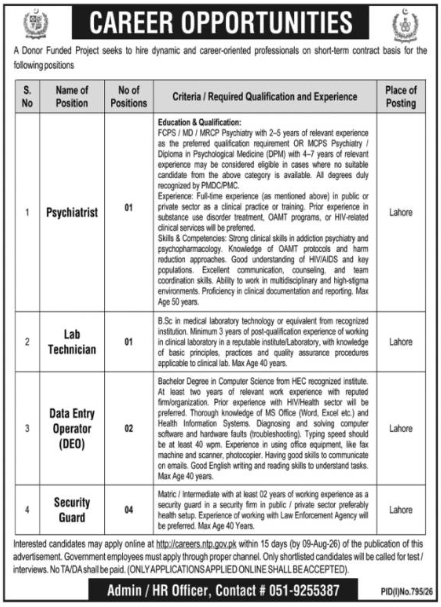
- Salary Offer 75000-85000 USD 75000-85000 Month
- Address Islamabad, Islamabad, Pakistan
- Age limit 20-30
- Gender Both
- Job Sector Government
- Apply Through By Hand
- Job Authority
- Number of Post Multiples
- Education Matric | Intermediate | Bachelor | DAE | MBBS | Others | BS
- TA/DA No
- Domicile Punjab,Sindh,Balochistan,kpk
- Newspapper Nation Jobs
- Experience Required Fresh Can Apply
- Official Website https://www.nation.com.pk/E-Paper/karachi/2026-07-25/page-2
| Posted On | |
|---|---|
| Company: | |
| Location: | |
| Job Type: | |
| Last Date: |
Jobs Positions
The National TB Control Program (NTP) Pakistanof , operating under the Common Management Unit (CMU) of the Ministry of National Health Services, Regulations and Coordination, is the country’s primary initiative to prevent, detect, and treat tuberculosis (TB). Pakistan remains one of the world’s highest TB burden countries, making the program essential for protecting public health. The current National Strategic Plan (2024–2026) focuses on reducing TB incidence and mortality through improved diagnosis, treatment, prevention, and community engagement.
C
Common Management Unit
+1
In 2026, the National TB Control Program continues to provide free TB diagnosis and treatment across a nationwide network of more than 1,700 public and private TB care facilities. These services include sputum testing, chest X-rays, rapid molecular diagnostic tests such as GeneXpert, drug-susceptibility testing, and standardized treatment for both drug-sensitive and drug-resistant TB. The government has strengthened laboratory services to ensure early and accurate diagnosis, helping patients begin treatment before the disease spreads further.
C
Common Management Unit
+1
A major priority of the program is the early detection of tuberculosis. Health workers actively screen individuals with persistent cough, fever, night sweats, weight loss, or close contact with TB patients. Mobile screening units, digital X-ray services, and community outreach campaigns are used to reach vulnerable populations in remote and underserved areas. Increased use of molecular diagnostic technology has significantly improved the speed and accuracy of TB detection throughout Pakistan.
E
EMRO
+1
The program also places strong emphasis on the management of drug-resistant tuberculosis (DR-TB). Patients diagnosed with resistant forms of TB receive specialized treatment at designated treatment centers. To improve treatment adherence, eligible DR-TB patients receive financial support during their treatment period, helping reduce the economic burden associated with long-term therapy. Modern treatment regimens and regular patient monitoring have contributed to better treatment outcomes.
C
Common Management Unit
+1
The National Strategic Plan 2024–2026 outlines ambitious goals for reducing TB deaths and increasing access to quality care. The strategy promotes universal health coverage, stronger surveillance systems, enhanced infection prevention, digital patient monitoring, and closer collaboration between public and private healthcare providers. It also prioritizes preventive treatment for high-risk groups, including household contacts of TB patients, children, and people with weakened immune systems.
C
Common Management Unit
+1
Pakistan has expanded collaboration with international organizations such as the World Health Organization (WHO) and the Global Fund to strengthen TB control efforts. These partnerships support laboratory improvements, healthcare worker training, procurement of medicines and diagnostic equipment, public awareness campaigns, and implementation of updated treatment guidelines based on the latest WHO recommendations. Recent updates include shorter treatment regimens for selected patients and expanded preventive therapy for individuals at high risk of developing active TB.
E
EMRO
+1
Community awareness remains another important component of the National TB Control Program. Educational campaigns encourage people to seek medical attention if they experience TB symptoms for more than two weeks. The program also works to reduce stigma associated with tuberculosis by promoting accurate information through schools, healthcare facilities, media campaigns, and community health workers. Public participation is considered essential for achieving national TB elimination targets.
P
Provincial TB Control Program
+1
Digital innovation has become increasingly important in TB control. Electronic reporting systems, case-based surveillance, digital adherence technologies, and improved data management help health authorities monitor patients, identify outbreaks, and evaluate program performance. These digital tools support faster decision-making and improve coordination among healthcare providers at national and provincial levels.
D
Devex
+1
Despite substantial progress, Pakistan continues to face challenges including delayed diagnosis, treatment interruption, multidrug-resistant TB, poverty, malnutrition, and limited healthcare access in some regions. The National TB Control Program addresses these issues through strengthened primary healthcare services, active case finding, community partnerships, and expansion of preventive treatment. Provincial TB programs also continue to improve screening, rapid molecular testing, and patient follow-up to enhance treatment success.
D
DGHS Punjab
+1
In conclusion, the National TB Control Program 2026 represents Pakistan’s comprehensive effort to eliminate tuberculosis through early diagnosis, free treatment, modern diagnostic technology, community awareness, digital health systems, and international collaboration. By implementing the National Strategic Plan (2024–2026), expanding access to quality TB services, and focusing on prevention and patient-centered care, Pakistan aims to significantly reduce TB transmission, improve treatment outcomes, and move closer to ending tuberculosis as a major public health threat.
C
Common Management Unit
+2
C
E
P
Sources